FLAT RATE SHIPPING – ONLY $6.99 ENJOY ONE EASY SHIPPING RATE ON EVERY ORDER

In the world of high-end skincare, a curious paradox has emerged. A consumer walks into a luxury boutique, lured by the promise of botanical extracts, scientific breakthroughs, and the heritage of brands like Kiehl’s or L’Occitane. They find a product that is, by all accounts, “great”—a formula that performs beautifully on the skin. Yet, for a growing movement of indie makers and eco-conscious consumers, the experience is immediately soured by the touch of the container. To these observers, the high-quality cream inside is betrayed by what can only be described as “shit plastic packaging.”
This friction is at the heart of a major shift in the beauty industry. For many boutique botanical makers, the sight of a global brand using “fancy plastic” doesn’t signal luxury; it signals a “junk product”. This sentiment raises a profound question about the history and future of the industry: How did we move from the enduring elegance of natural materials to the ubiquity of plastic, and how are modern indie brands leading the charge to reclaim a more sustainable heritage?
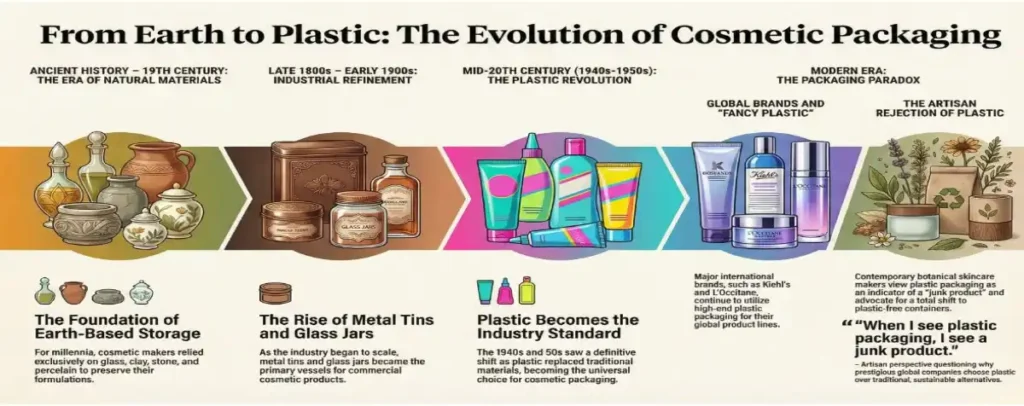
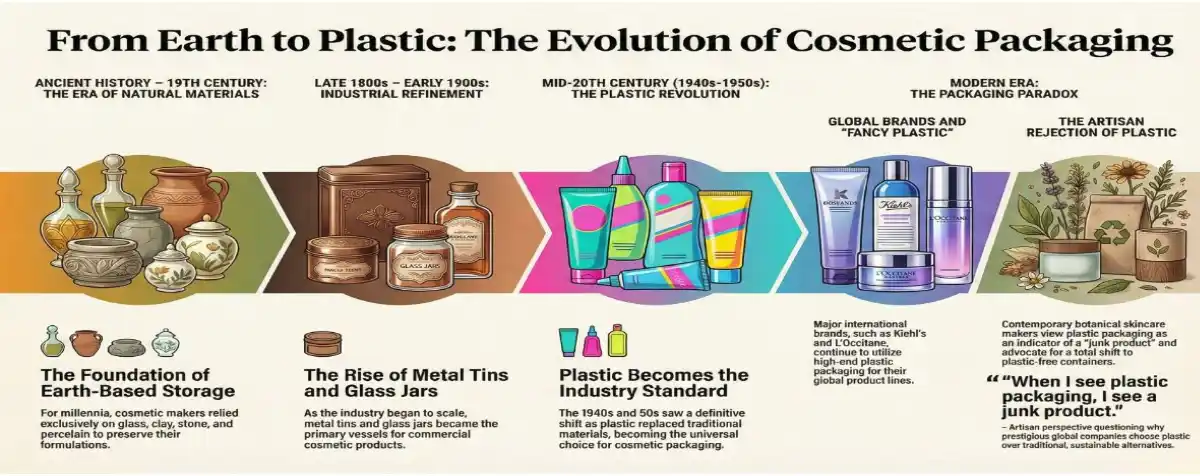
Long before the invention of synthetic polymers, cosmetic makers relied on the earth to house their creations. In the ancient world, the container was often as much a work of art as the formula itself. Ancient Egyptians, pioneers of the beauty industry, utilized ornate stone jars, carved alabaster, and colored glass bottles to store their precious oils and ointments. These materials were chosen not just for their beauty, but for their ability to protect the contents from light and heat.
As we moved into the late 19th and early 20th centuries, the industry maintained a standard of permanence and weight. Creams were almost exclusively housed in porcelain or ceramic pots, while early lipsticks were sold in paperboard tubes or intricately designed metal tins. During this time, the “junk” sentiment noted in our modern era would have been incomprehensible; if a product was valuable, its housing reflected that value. Glass was the gold standard for liquids, providing a non-reactive environment that ensured the botanical stability of the formulas.
The shift away from these traditional materials wasn’t accidental—it was a revolution of convenience and cost. The transition began in earnest following World War II in the 1940s and 50s. As plastic manufacturing technology advanced, it offered global cosmetic makers an irresistible value proposition: it was virtually unbreakable, incredibly lightweight, and, most importantly, cheap to produce.
By the 1960s and 70s, plastic had become the industry standard. Global brands began to see the logistical benefits of shifting away from glass and metal. Plastic allowed for easier global shipping, reduced the risk of breakage in transit (and in the customer’s bathroom), and allowed for a new era of “squeezable” convenience.
However, as the sources suggest, this transition created a lasting aesthetic and ethical disconnect. Major global brands began to master the art of “fancy plastic”—packaging engineered to mimic the weight and sheen of more expensive materials, yet remaining fundamentally disposable. To the corporate eye, this was a masterpiece of engineering; to the modern botanical maker, it was the moment the industry lost its soul, choosing a “junk” exterior for high-quality contents.
One of the most pressing questions for modern consumers is: “Why don’t they see what I see?”. Why do multi-billion dollar companies continue to use plastic when the environmental cost is so clear?
From a corporate standpoint, the justification often centers on scalability and protection. Plastic can be engineered with specific barriers to protect complex, light-sensitive ingredients more effectively (and cheaply) than many sustainable alternatives. Furthermore, the weight of plastic is a significant factor in a brand’s carbon footprint during transport; ironically, while plastic is a pollutant, its lightness can sometimes result in lower shipping emissions compared to heavy glass.
Additionally, there is the psychological element of the “fancy plastic” mentioned in our sources. Global giants believe that consumers associate the sleek, branded look of their custom-molded plastic with modern luxury. They fear that a return to simpler, heavier materials might alienate a mass market that has grown accustomed to the “unbreakable” convenience of the modern bathroom.
The Indie Revolution: Prioritizing Infinitely Recyclable Materials
In response to this corporate reliance on plastic, a new wave of indie botanical brands is emerging. These makers don’t just see plastic as an environmental hazard; they see it as a mark of low quality. For these brands, the goal is to align the integrity of the packaging with the integrity of the botanical ingredients.
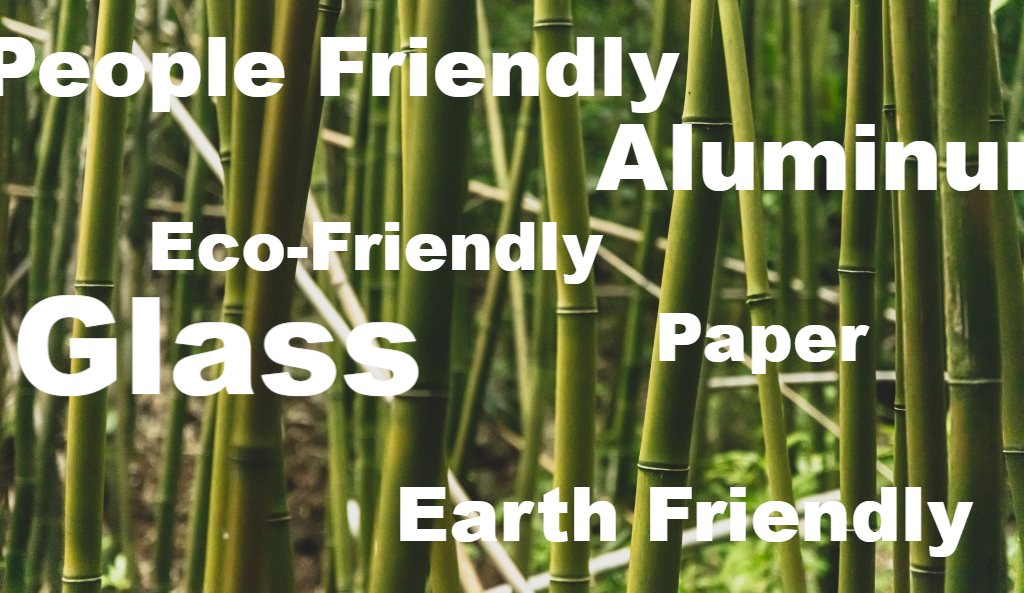
Glass is making a massive comeback, but with a modern twist. Indie brands are opting for miron (violet) glass or heavy, frosted glass that offers superior UV protection for natural ingredients without the need for synthetic stabilizers. Unlike plastic, which degrades in quality every time it is recycled, glass is infinitely recyclable, maintaining its purity and quality forever.
Aluminum is perhaps the most effective weapon in the indie brand’s arsenal against plastic. It is lightweight (addressing the shipping concerns of global brands) yet highly durable. More importantly, it has one of the highest recycling rates of any material. Because it can be melted down and repurposed endlessly without losing its structural integrity, it represents a truly “circular” packaging solution.
Beyond metal and glass, the most cutting-edge indie brands are looking toward the earth itself. We are seeing the rise of:
• Seed-paper boxes that can be planted after use.
• Mushroom packaging (mycelium) that serves as a biodegradable alternative to Styrofoam or plastic inserts.
• Seaweed-based films that dissolve in water, perfect for single-use samples or outer wraps.
The source asks whether the major brands are simply “wrong” for their choices. The answer is complex. While global brands are often trapped by their own massive supply chains, indie brands are proving that plastic-free can scale if done thoughtfully.
To move away from the “junk” of plastic, brands are increasingly looking at refillable systems. By selling a “forever bottle” made of high-quality glass or stainless steel and providing refills in lightweight, recyclable aluminum or compostable pouches, brands can reconcile the need for luxury with the demand for sustainability. This “circular” model bypasses the need for the “fancy plastic” that so many find distasteful in the current market.
The evolution of cosmetic packaging has come full circle. We began with natural materials, detoured into a half-century of plastic dominance, and are now returning to a place where the exterior must match the interior.
As indie botanical makers continue to challenge the status quo, the pressure on global giants like Kiehl’s and L’Occitane will only increase. The modern consumer is beginning to agree with the sentiment found in our source: it is no longer enough to have a “great product” if it is housed in “shit packaging”. The future of beauty belongs to those who see that the bottle is not just a container, but a testament to the brand’s values. By prioritizing infinitely recyclable and biodegradable materials, the next generation of beauty brands is ensuring that the industry’s legacy is as beautiful as the products it creates.

I’m Jay, the “do-everything” guy behind Wenonah—though my family jokingly calls me Blossom (a nickname that stuck despite my protests). I spend my days in denim and Red Wing boots, crafting small-batch botanical body care in Winona, Minnesota. Here, I’ll share the stories behind the formulas, the ingredients I love, and why I believe your daily rituals deserve better than drugstore defaults.
Our store remains open, but please note that shipping is paused from June 3 through June 26, 2025. Orders placed during this time will begin shipping the first week of July.
Thank you for your patience and for supporting Wenonah!